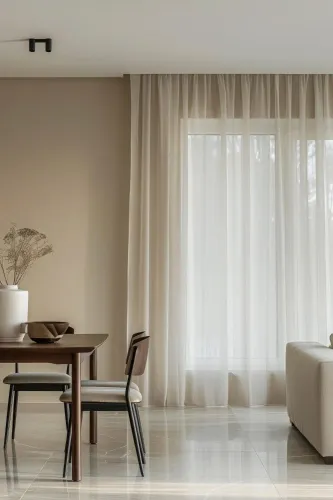
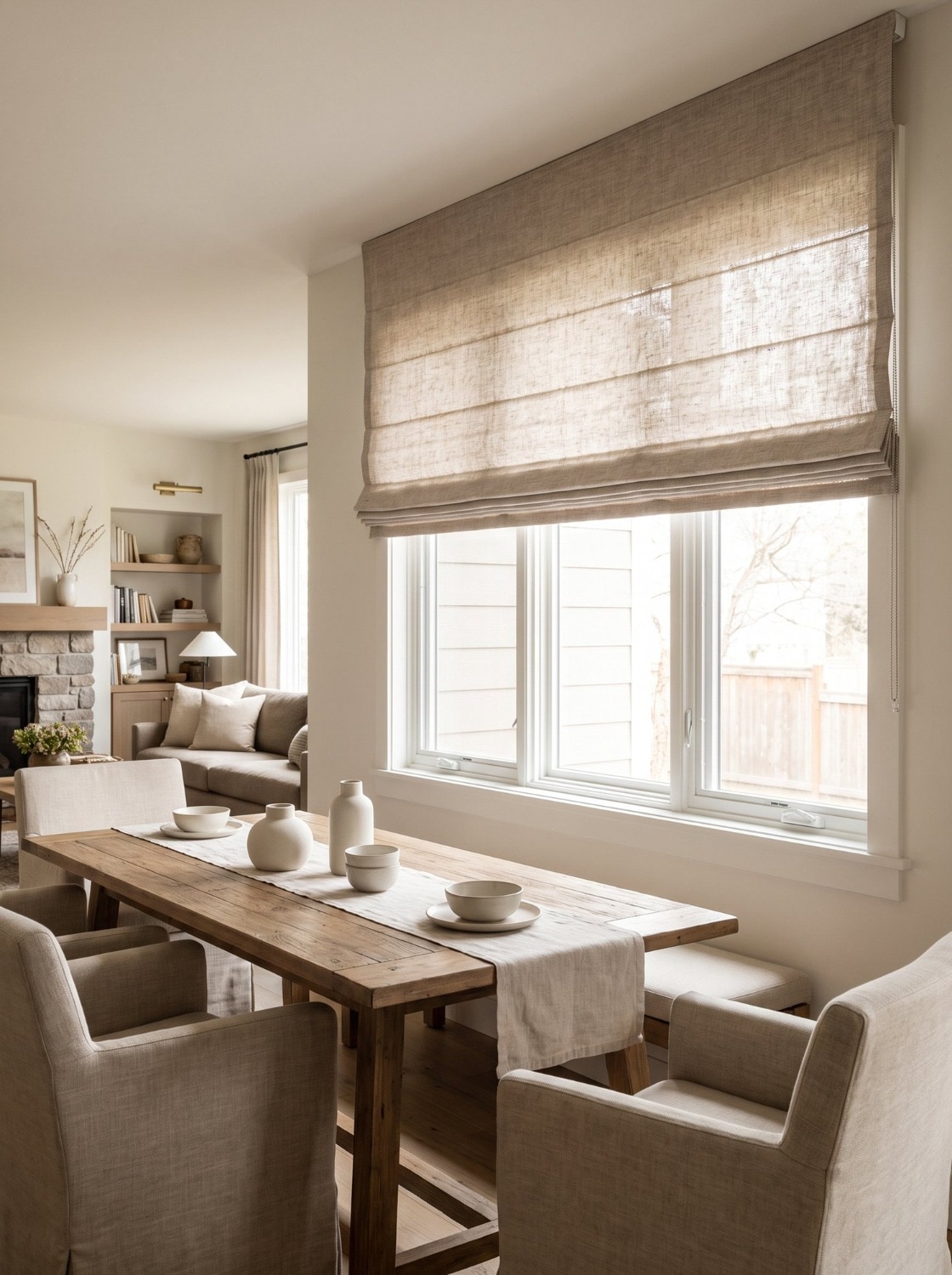
A Roman blind can look crisp and architectural or soft and decorative, but the result depends on more than choosing a neutral fabric. By the end, you will know how to match the fold, fabric, mounting method, operation, and light control to your room, window, and daily use.
Key takeaways
- Choose flat folds for a quiet modern look and relaxed folds for softer traditional rooms.
- Measure the recess at three points before ordering or cutting the fabric.
- Specify privacy, glare control, insulation, and abrasion resistance as separate fabric requirements.
- Compare Roman blinds with roller, curtain, and cellular shades before committing.
The construction details that make one Roman blind modern and another traditional
The fold, fabric structure, edge finish, and hardware profile decide whether Roman blinds look contemporary or classic. Modern Roman blinds usually keep the front plane quiet, while traditional Roman blinds use visible softness, pattern, and ornament.
| Style | Construction choices | Why it works |
|---|---|---|
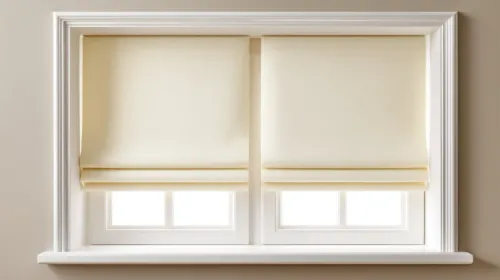
| Minimalist | Flat fold; plain fabric; concealed battens; narrow side returns; no contrast trim | Creates uninterrupted horizontal lines and a crisp architectural finish |
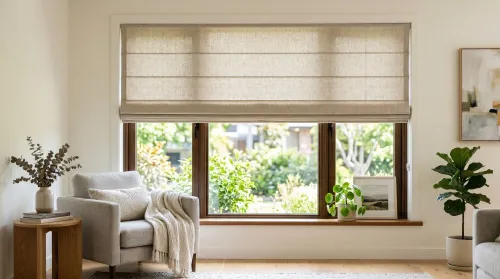
| Scandinavian | Flat fold or lightly relaxed fold; pale linen-look fabric; natural texture; simple lining | Adds warmth without visual clutter, especially in white, oat, grey, or muted blue |
| Transitional | Flat fold; medium-weight woven fabric; subtle stripe or geometric pattern; self-coloured piping | Bridges clean modern lines and traditional detailing without looking formal |
| Traditional | Hobbled fold; fuller fabric; floral, damask, or toile pattern; contrast edging or decorative lining | Builds the layered depth and softness associated with classic rooms |
| Maximalist | Hobbled or relaxed fold; large-scale print; contrasting border; mixed texture or bold lining | Makes the blind a deliberate decorative feature rather than background dressing |
Consider the raised stack before choosing a pattern. Horizontal folds interrupt vertical motifs, and a large repeat can disappear into the stack, so approve a folded fabric sample rather than judging the cloth flat.
A flat fold suits rooms where geometry matters; a hobbled fold suits rooms that need movement and depth. Hardware also affects the result: a slim headrail and discreet chain support a modern scheme, while a visible wood batten or decorative trim reinforces a traditional one.
Choose the fold and control system around how you use the window
The fold should follow how often you raise the blind, how much glass you need to uncover, and whether the window opens inward. Roman blind fold styles change the room’s character, the size of the fabric stack, and how easily you reach handles, locks, and vents.
| Fold | Appearance and stacking | Handling and window access |
|---|---|---|
| Flat | Crisp, orderly, and suited to modern rooms; its broad folds create a relatively compact stack. | Raises smoothly, but the stack can still cover upper glass. Keep it clear of handles and opening casements. |
| Hobbled | Layered folds add depth and a more traditional, tailored appearance; the thicker construction creates a larger stack. | Handles well when fully supported, but needs extra clearance above the frame and can obstruct more of the view when raised. |
| Relaxed | A soft centre dip gives a casual, decorative finish; the folds collapse less tightly and occupy more space. | Best for windows opened less frequently. The fabric can hang near handles or furniture unless the mount and finished drop provide clearance. |
Cord and chain controls suit reachable windows and give direct manual adjustment, but the operating side must remain accessible. Keep control loops away from children and pets, and do not place furniture where it blocks the chain.
Roman blind motorisation earns its cost on tall, wide, or hard-to-reach windows, and on blinds children could access. Confirm the motor supports the blind’s fabric weight and dimensions, then plan battery charging or a wired supply, control compatibility, and future servicing before installation.
Measure the recess before the fabric is cut
Measure to the millimetre, because a Roman blind must clear hardware as it folds, not merely cover the visible glass. Roman blind measuring should account for the full recess, the opening sash, and the fabric stack above the window.
1. Check whether the recess is suitable for inside-mount Roman blinds. Measure the window recess depth from the front edge to the glass, sash, handle, vent, or lock that projects furthest. Compare this measurement with the blind’s headrail and folded-fabric depth; insufficient space can stop the sash opening or make the blind foul its hardware.
2. Measure the recess width at the top, middle, and bottom, then measure the height at the left, centre, and right. Record every result in millimetres. Use the narrowest width for an inside mount, and check which height leaves the blind clear of the sill.
An uneven recess can leave visible side gaps or prevent the blind from sitting square.
3. Choose outside-mount Roman blinds when the recess is too shallow, the window is badly out of square, or you need to cover side gaps. Measure the finished blind width and height instead of the glass, extending beyond the recess enough to overlap its edges and clear handles, vents, and the opening sash.
4. Mark the proposed headrail and raise the blind on paper before ordering. Confirm that the stacked folds will not cover an important upper view, collide with a ceiling or cabinet, or block the window when opened.
Treat privacy, glare, insulation, and fabric durability as separate decisions
Choose fabric and lining separately for privacy, glare, insulation, and durability; no single Roman blind treatment solves all four.
Privacy: A sheer or translucent fabric admits daylight but offers little night-time privacy when your room is lit. Roman blind privacy improves with a denser cloth, an outside mount, or a close-fitting recess; inside mounts still leave side gaps.
Glare: A dimout lining reduces harsh sunlight without making the room dark. Blackout Roman blinds block light through the fabric, but light can still enter around the headrail, side edges, and bottom edge.
Insulation: Interlined Roman blinds add thickness, drape, and some resistance to heat transfer. They do not compensate for poor glazing, frame leakage, or an ill-fitting blind.
Durability: Direct sunlight fades vulnerable fabrics, while humidity can stain, distort, or encourage mildew, especially in kitchens and bathrooms. Choose a washable, moisture-suitable fabric where exposure is unavoidable.
The lining and fabric also determine the raised stack. Thick cloth and interlining create a heavier, deeper stack that covers more glass and places greater load on the operating system. Check the manufacturer’s weight and width limits before choosing motorisation; a motor does not make an oversized or damp-prone blind suitable.
Compare Roman blinds with the alternatives before you commit
Roman blinds are the better choice when you want fabric softness, a tailored shape, and a compact raised position without full-length drapery. They suit shallow rooms and windows where curtains would crowd furniture, but their stacked folds can hide upper glazing and require more clearance than a roller blind.
| Option | Roman blinds versus the alternative | Choose Roman blinds when |
|---|---|---|
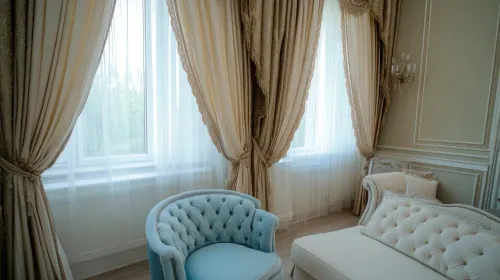
| Roman blinds versus curtains | Less fabric at floor level, but less flexible for covering wide openings and side gaps | You want a neat, upholstered appearance or sill-level treatment |
| Roman blinds versus roller blinds | More texture and acoustic softness, but a larger top stack and more precise clearance | Appearance matters more than keeping every centimetre of glass visible |
| Roman blinds versus wooden blinds | Softer and quieter, but less tolerant of moisture and heavy handling | You want pattern, lining, or a relaxed fabric finish rather than slatted light control |
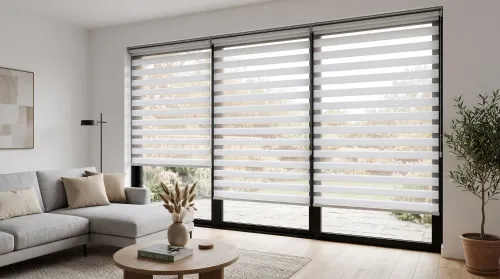
| Roman blinds versus Zebra blinds | More decorative and substantial, but without Zebra blinds’ quick alternating sheer-and-opaque adjustment | You prioritise coordinated fabric and blackout lining over instant strip-by-strip control |
Professional fitting earns its cost on uneven recesses, deep handles, opening casements, wide blinds, and blackout installations. The fitter should check the headrail, fold stack, vents, locks, side gaps, and lifting load rather than measure only the visible glass. Blinds N Curtains can help resolve those clearance and split-blind decisions before fabrication.
Choose motorisation for a tall, wide, hard-to-reach, or child-accessible blind, then confirm power, controls, maintenance, and the manufacturer’s weight limit. For a small, accessible window, a correctly measured manual blind is usually the simpler choice.
Related product
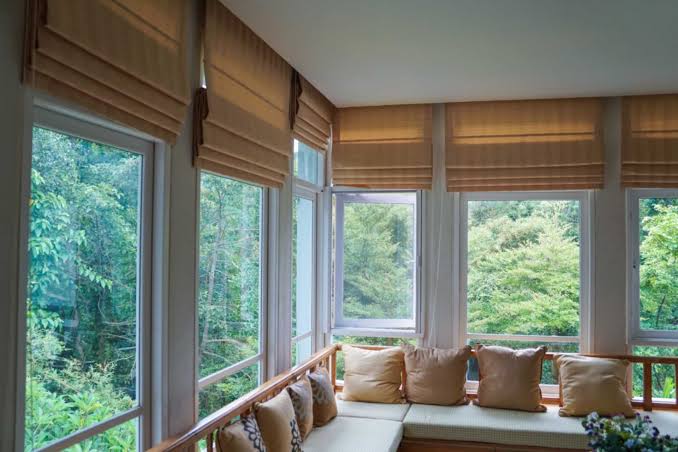 | Roman Blinds Elevate your interior space with the timeless elegance and refined functionality of custom Roman Blinds from Blinds N Curtains. View product → |
Frequently asked questions
What makes a Roman blind look modern or traditional?
Flat folds, plain fabrics, crisp edges, and discreet hardware create a modern look. Relaxed folds, patterned or textured fabrics, visible softness, and decorative trims create a traditional look.
How should you choose a Roman blind fold and control system?
Choose the fold based on the desired appearance and how often you operate the blind. Select a chain, cord-free, or motorised control according to window access, safety, and convenience.
How do you measure a recess for Roman blinds?
Measure the recess width and height at three points, record the smallest width, and check for handles, tiles, architraves, and obstructions before the fabric is cut.
What should Roman blind fabric provide besides appearance?
Assess privacy, glare reduction, insulation, and durability separately because one fabric rarely performs equally well in every category.
What alternatives should you compare with Roman blinds?
Compare Roman blinds with roller blinds, curtains, and cellular shades for stack height, light control, insulation, cleaning, operation, and suitability for the window.