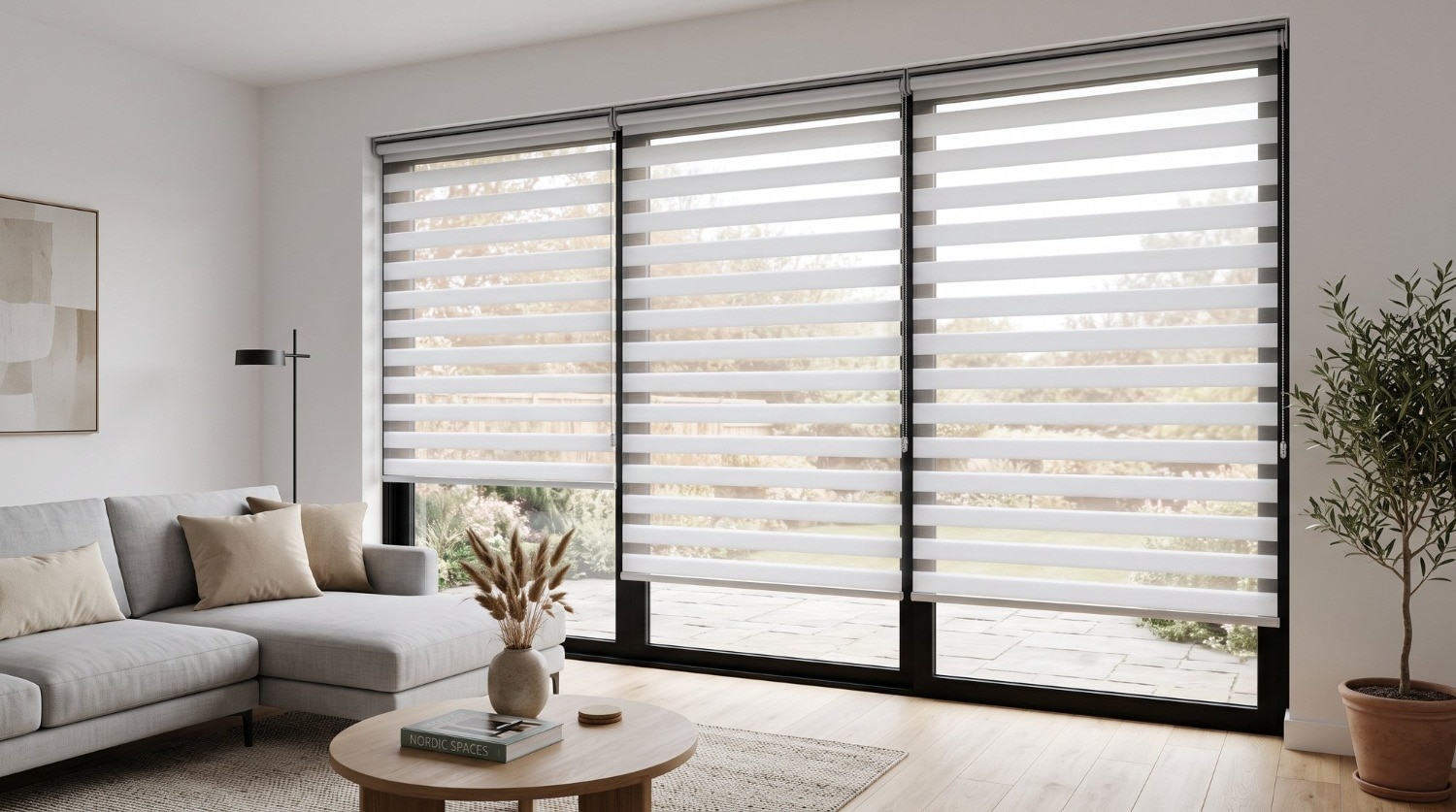
The result depends on more than lowering the shade: the fabric overlap, window direction, mounting position, and indoor lighting all change what you see and what people outside can see. By the end, you will know which setting to use, when zebra blinds will fall short, and what to check before choosing or installing them.
Key takeaways
- Align sheer and opaque bands to adjust incoming daylight.
- Close the bands for daytime privacy without fully blocking light.
- Use room-darkening fabric when sleeping conditions matter.
- Check window depth, recess clearance, and control access before installation.
How the Two Fabric Layers Change the Light
Two layers of horizontally striped fabric form a zebra blind: each layer alternates translucent bands and opaque bands. The layers slide against each other inside a headrail, so changing their alignment controls the light; raising the shade is a separate action. This is the core zebra blind construction, not a single fabric with printed stripes.
| Part | Function |
|---|---|
| Headrail | Houses the fabric layers and supports the shade |
| Roller tube | Winds the fabric as you raise the blind |
| Bottom rail | Weighs the fabric and helps it hang straight |
| Control mechanism | Shifts one layer against the other or raises and lowers the shade |
| Operating position | Daylight and view |
|---|---|
| Translucent bands aligned | Admits the most daylight and preserves the most outward view, but gives weaker glare control and privacy |
| Opaque bands overlapping | Blocks more direct light and creates greater privacy, while reducing useful daylight and the view |
| Intermediate alignment | Softens incoming light and partly limits the view; it is not the same as a continuously adjustable dimmer |
| Shade raised | Leaves the window fully open for an unobstructed view and maximum daylight |
Aligning the opaque bands does not automatically create blackout conditions. A light-filtering fabric still diffuses daylight through its material, so choose a blackout-rated zebra fabric when you need a room dark enough for sleeping, projection, or photographic work.
What Privacy You Get During the Day and at Night
A bright room facing a darker exterior gives you the strongest daytime privacy. With the opaque bands aligned over the translucent bands, people outside may see softened shapes rather than a clear view, but close observers can still see through gaps or translucent sections. Raise the blind, and privacy drops immediately.
Test the actual sightlines from:
- Normal eye level across the street or courtyard
- A higher floor, balcony, or stair landing
- The side of the window, where the viewing angle changes
Nighttime privacy reverses the daytime advantage. Interior lights make your room brighter than the glass, so people outside may see silhouettes through blinds, movement, and interior details through the translucent fabric. Closing the bands improves privacy, but it does not make every installation opaque from every viewpoint.
Outside mounting overlaps the recess more completely, reducing edge views and helping privacy. Inside mounting leaves a cleaner trim line but cannot cover an out-of-square opening or the full recess. If a window faces a nearby walkway or building, add another opaque layer rather than relying on closed bands alone.
Light Filtering, Glare Reduction, and Room Darkening Are Different
Light filtering softens daylight; glare reduction limits harsh reflections on screens and glossy surfaces; room darkening blocks enough light for sleep or projection. These results are different, so aligning the opaque bands does not automatically create blackout conditions.
Check each window orientation before choosing the fabric:
- East-facing windows receive low morning sun, which can cause glare across beds, desks, and televisions. Choose stronger glare reduction if you use the room early.
- West-facing windows receive intense afternoon and evening sun. A darker solar fabric, outside mount, or blackout zebra blinds gives better control of glare and heat.
- South-facing windows in New Delhi receive substantial direct sun, especially around midday and during sunnier months. Select fabric based on the glazing, interior use, and desired heat control.
- North-facing windows usually provide steadier, softer daylight with less direct glare. Light filtering is often sufficient unless the room needs darkness for sleep or media.
You need more than light filtering when the room must become genuinely dark for sleeping, a projector, nursery naps, or photographic work. Select a blackout-rated fabric, then address edge leakage: inside mounts leave sightlines at the sides and recess, while an outside mount with overlap or side channels blocks more light.
A fully lowered shade also performs better than a partially raised one.
How Zebra Blinds Compare With Other Window Coverings
Zebra blinds are the stronger choice when you want adjustable daylight, a changing level of privacy, and a compact, uncluttered fit. They are a weaker choice when you need complete darkness, maximum insulation, or a substantial decorative layer.
| Option | Zebra blinds are better when | Choose the other covering when |
|---|---|---|
| Zebra blinds versus roller blinds | You want to shift between filtered light, privacy, and an open view without raising the shade. | A roller blind’s single fabric gives simpler operation, a cleaner blackout specification, or a lower-cost solution. |
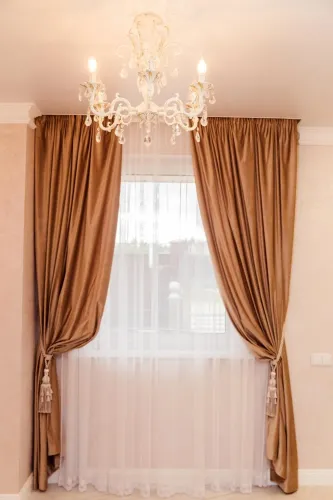
| Blackout curtains | You want privacy and glare control without covering the entire wall with fabric. | You need near-total darkness for sleep, projection, or photography; use properly fitted blackout curtains or a blackout shade. |
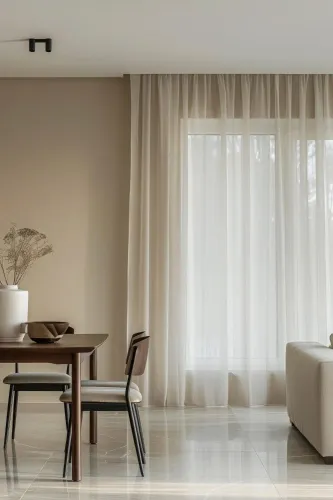
| Sheer curtains | You want adjustable privacy instead of a permanently translucent layer. | You want soft, continuous daylight and a relaxed, fabric-draped appearance. |
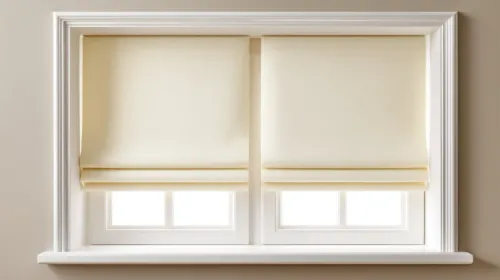
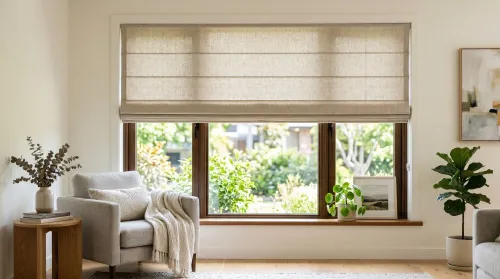
| Roman blinds comparison | You prefer horizontal band adjustment and a slimmer headrail. | You want pleats, folds, richer textile texture, or a stronger traditional focal point. |
| Wooden blinds | You want quick, fine control over light without rotating slats. | You need natural timber character, stronger visual structure, or ventilation through tilted slats. |
No option wins every window. A fully lowered zebra blind can reduce glare, but a dark fabric, exterior shade, or lined curtain does more for west-facing heat and serious room darkening. For large openings, blackout curtains also provide better overlap at the edges than a narrow inside-mounted shade.
What to Check Before Measuring and Installing Them
The window, fitting method, and control system decide whether zebra blinds operate smoothly. Accurate window blind measuring must record width and height at several points, plus handle projection, crank mechanisms, mullions, trim depth, and clearance for the roll or cassette.
| Option | Check before ordering | Consequence if missed |
|---|---|---|
| Inside mount versus outside mount | Confirm recess depth, frame condition, and desired coverage | An inside mount can leave side, top, and bottom light gaps; an outside mount covers more of the opening |
| End brackets versus centre support | Check the shade’s finished width and weight against the manufacturer’s bracket schedule | A wide shade can sag, twist, or pull fixings from the wall |
| Manual versus cordless blinds | Select a control that keeps operating cords away from children; secure any continuous loop as specified | Accessible cords create a strangulation hazard even after careful installation |
Before approving the order, check these project requirements:
- Confirm the fixing surface: plasterboard may need anchors, while masonry or timber needs suitable screws and plugs.
- Choose a light-filtering fabric for diffused daylight; specify blackout fabric for sleeping, projection, or photographic work. Add an outside mount, overlapping frame, or side channel when perimeter light matters.
- For offices, hotels, or other commercial spaces, request flame-performance documentation such as NFPA 701, cleanability details, accessibility provisions, and control-system integration.
- Ask for cleaning instructions and plan motorized blinds maintenance, including battery or charging access. Never force a stiff chain or bottom rail.
- Blinds N Curtains can verify obstructions and fixing points during a site measure, preventing a correctly made shade from colliding with a handle.
Related product
 | Zebra Blinds Transform your living spaces with the modern elegance and functional versatility of Zebra Blinds from Blinds N Curtains. View product → |
Frequently asked questions
How do the two fabric layers in zebra blinds control light?
Each layer has alternating translucent and opaque bands. Aligning the bands lets in more light, while overlapping opaque bands blocks more light.
Do zebra blinds provide privacy at night?
Yes, when the opaque bands overlap, but artificial indoor light can still reveal silhouettes through translucent sections. Close the blind fully for stronger privacy.
Are light filtering, glare reduction, and room darkening the same?
No. Light filtering softens daylight, glare reduction limits harsh reflections, and room darkening blocks far more light for sleeping or media rooms.
How do zebra blinds compare with other window coverings?
Zebra blinds offer adjustable light and privacy in one shade, while curtains, roller blinds, and horizontal blinds differ in insulation, view control, appearance, and darkness.
What should you check before measuring and installing zebra blinds?
Check whether the blind will mount inside or outside the recess, measure width and drop at multiple points, confirm headrail clearance, and plan for handle and control access.